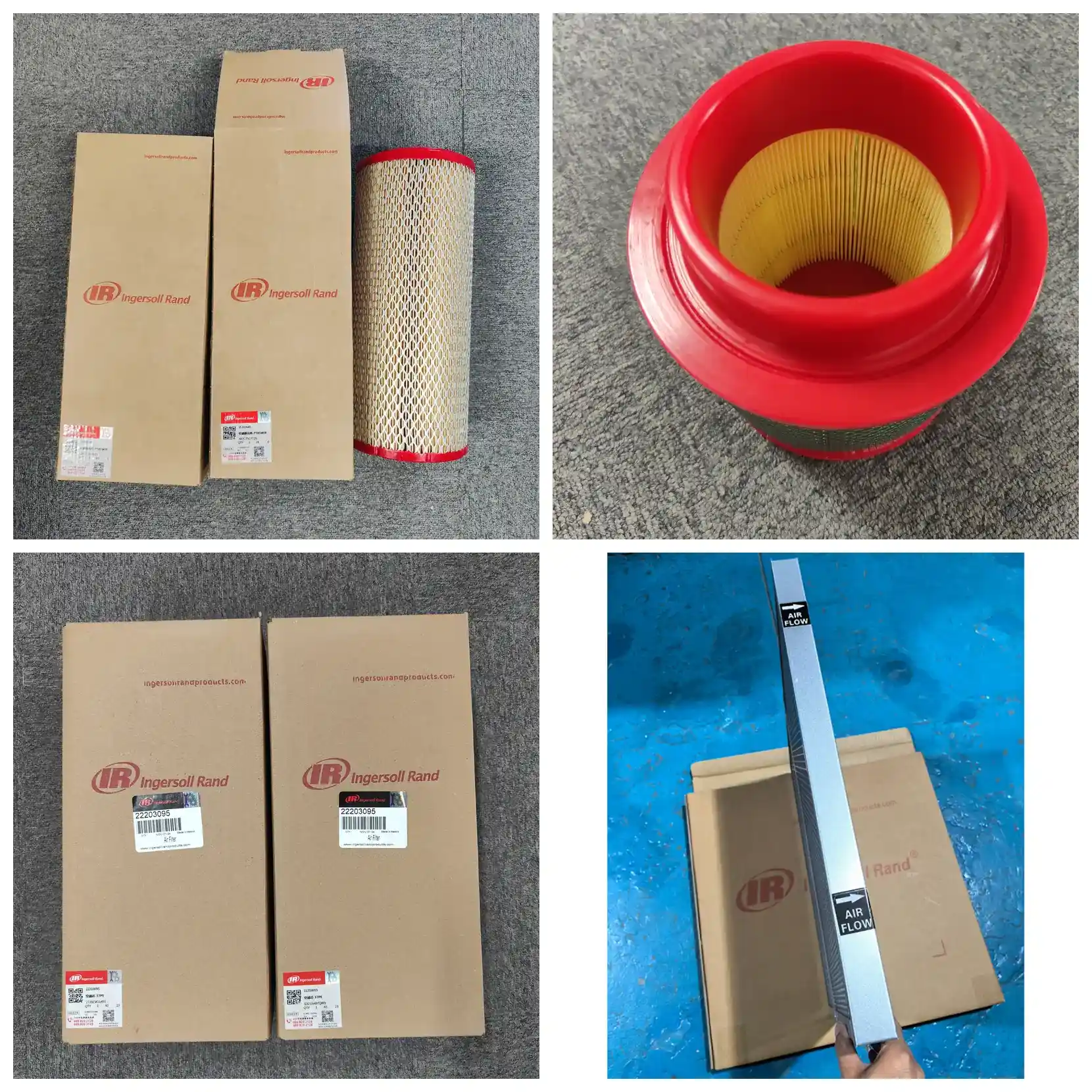
Product
Ingersoll Rand 89874439 Air Filter Element | MSG TURBO-AIR & CENTAC
Genuine Ingersoll Rand 89874439 intake air filter element for MSG TURBO-AIR and MSG CENTAC centrifugal compressors. 215 mm OD × 110 mm ID × 188 mm H, approx. 2.0 m² filtration area, 5–10 μm rating, ≥98% efficiency. Export-ready with serial-number fitment verification.
- Export packaging & documentation support
- OEM / ODM customization available
- Sample and bulk order workflow
Product Overview
89874439 is the intake air filter element for Ingersoll Rand MSG TURBO-AIR and MSG CENTAC centrifugal air compressors.
It mounts inside the intake filter housing, upstream of the first-stage impeller and inlet guide vanes. Centrifugal compressors accelerate air through a high-speed impeller and convert velocity into pressure — the air must be clean before it reaches the first stage. This filter element is the only particle barrier protecting the impeller blades and intercooler passages.
Why this matters more on a centrifugal machine: these are 100% oil-free compressors. There is no lubricating oil in the compression chamber to wash contaminants away. Dust that enters deposits on the impeller, diffuser, and intercooler tube bundles. Impeller fouling changes dynamic balance and aerodynamic efficiency; intercooler fouling raises interstage temperature and reduces overall efficiency. These units are typically continuous-duty main machines (90–4200 kW), so one unplanned stop costs far more than the filter itself.
You do not need to open the machine or use tools to judge whether this element needs changing — just read the gauge. While the compressor runs, check the intake depression gauge: green zone means the element still has life, yellow means schedule a replacement, red means it is past the change point and the unit is running at elevated specific power.
Core Specifications
| Item | Value |
|---|---|
| Part Number | 89874439 |
| Product Name | Air Filter Element |
| Application Series | MSG TURBO-AIR / MSG CENTAC centrifugal compressors |
| Construction | Dry pleated cartridge, disposable |
| Quantity per Unit | 1 (large machines use multiple elements per configuration) |
| Dimensions | 215 mm OD × 110 mm ID × 188 mm H |
| Effective Filtration Area | Approx. 2.0 m² |
| Filtration Rating | 5–10 μm |
| Filtration Efficiency | ≥98% |
| Recommended Change Interval | Approx. 2000 hours or 3 months, or when the intake depression gauge enters the yellow zone |
Technical Parameters
1. Filtration Performance
| Parameter | Value / Notes |
|---|---|
| Filtration Rating | 5–10 μm |
| Filtration Efficiency | ≥98% (for particles ≥5 μm) |
| Filter Classification | Not assessed under EN 779 HVAC filter classes; centrifugal intake elements are characterized per ISO 5011 by efficiency, intake resistance, and dust holding capacity |
| Dust Holding Capacity | Approx. 600 g |
Why centrifugal compressors are more sensitive to filtration precision: impeller blade passages are narrow and rotational speeds are extremely high (tens of thousands of RPM). The relative impact velocity of particles against the impeller is far greater than in a screw compressor. A 10 μm particle causes more erosion damage on a centrifugal machine, and once the intercooler tube bundle fouls, cleaning requires shutdown and disassembly — unplanned overhaul work.
2. Flow and Resistance
| Parameter | Value / Notes |
|---|---|
| Rated Air Flow | Approx. 9 m³/min per element; actual quantity configured to machine intake, multiple elements in parallel |
| Filtration Face Velocity | Approx. 0.075 m/s |
| Initial Pressure Drop | Approx. 0.5–1.0 kPa (approx. 50–100 mmH₂O) |
| Operating Differential Range | Approx. 1.0–3.0 kPa (approx. 100–300 mmH₂O) |
| Alarm / Final Resistance | Determined by the intake depression gauge yellow zone; common engineering setting approx. 2.5–3.0 kPa (250–300 mmH₂O) |
| Pressure Drop vs. Energy | Each 1 kPa (approx. 100 mmH₂O) rise in intake depression raises specific power by approx. 1% |
Pressure drop and energy consumption: centrifugal compressor output depends on intake air density. As the filter loads with dust, intake depression rises, reducing both pressure and density entering the first stage. To maintain set discharge pressure and flow, the machine must increase speed or power — specific power rises, meaning more electricity per m³ of compressed air produced.
At a comparable order of magnitude to positive-displacement machines, each 1 kPa increase in intake depression raises energy consumption by roughly 1%. That ratio looks small, but centrifugal machines are medium-to-large units: on a 1000 kW machine running 8000 hours per year with depression 3 kPa past the change point, that is roughly 240,000 kWh per year — far more than the cost of a set of filter elements. This is why Ingersoll Rand fits an intake depression gauge as standard: it turns an invisible energy loss into a readable indicator.
3. Dimensions and Installation
| Parameter | Value / Notes |
|---|---|
| Dimensions | 215 mm OD × 110 mm ID × 188 mm H |
| Construction | Pleated (folded filter paper wound), cartridge type |
| Effective Filtration Area | Approx. 2.0 m² |
| Pleat Count | Approx. 106 pleats |
| Pleat Spacing | Approx. 4.8 mm |
| Mounting Interface | Cartridge end-face compression seal, fits into intake filter housing |
| Seal Type | End-face seal (axial compression) |
| Net Weight per Element | Approx. 1.2–1.7 kg |
Procurement note: when cross-checking a replacement, compare all three dimensions — 215 mm OD, 110 mm ID, and 188 mm height. Centrifugal intake elements and screw compressor elements are not interchangeable; they are designed for completely different intake volumes and face velocities.
4. Material Construction
| Parameter | Value / Notes |
|---|---|
| Filter Media | Imported wood pulp filter paper (industry-common US HV or Finland/Sweden Ahlstrom media) |
| Media Basis Weight | Approx. 130 g/m² |
| Inner / Outer Support | Galvanized steel perforated cage (inner support + outer guard), sheet thickness approx. 0.6 mm, open area ≥45% |
| End Caps | Metal end caps (galvanized steel) + polyurethane adhesive |
| Seal | Nitrile rubber (NBR) end-face seal ring |
| Bonding Layer | Polyurethane (PU) hot-melt adhesive |
5. Operating Conditions
| Parameter | Value / Notes |
|---|---|
| Operating Temperature | −10 to +100 °C |
| Relative Humidity | ≤80% RH, no condensation |
| Burst Strength | Filter paper burst strength approx. 200–400 kPa (per ISO 2758 paper burst test) |
| Collapse Resistance | Element designed for differential pressure ≥4.5 kPa |
| Special Functions | No flame-retardant, anti-static, or moisture-proof ratings noted for this model |
6. Service Life and Maintenance
| Parameter | Value / Notes |
|---|---|
| Service Life | Approx. 2000 hours or 3 months |
| Actual Change Interval | Based on intake depression gauge yellow zone; shorten in coastal (salt mist), desert (fine dust), or high-humidity environments |
| Shelf Life | Approx. 2–3 years (unopened, dry ventilated storage) |
7. Applicable Standards
| Item | Details |
|---|---|
| Product Standard | ISO 5011 (intake air filter performance testing for engines and compressors), evaluating efficiency, intake resistance, and dust holding capacity |
| Commonly Referenced Test Standards | ISO 2941 / 2942 / 2943 / 3723 / 3724 / 3968 |
| Standard Applicability Note | The ISO 29xx / 37xx series are actually general test methods for hydraulic transmission filters. If a supplier can only provide hydraulic filter standards, request ISO 5011 data or the OEM specification sheet. |
| Oil-Free Certification Context | The MSG TURBO-AIR / MSG CENTAC machines served by this element are ISO 8573-1 Class 0 oil-free certified; intake filtration is the first safeguard maintaining that oil-free rating |
Installation and Maintenance Steps
Working on a centrifugal machine differs from a screw compressor: the impeller has significant rotational inertia, so you must wait for the controller to confirm zero speed. A single job takes about 40–60 minutes, and larger housings may need two people or mechanical assistance.
- Shut down, confirm zero speed, lock out/tag out. Stop the machine and wait for the controller to confirm zero speed (centrifugal impellers have high inertia — do not judge by sound). Cut main power and apply lockout/tagout. Criterion: controller shows zero speed and no abnormal coasting noise.
- Locate the intake filter housing and release the clamps evenly. The housing is upstream of the inlet guide vanes. Release the end-cover clamps evenly in a diagonal sequence. Criterion: on large housings, have someone support the cover before the last clamp is released to prevent it dropping suddenly.
- Remove the old element and inspect the housing for dust tracks. Pull out the old element (use mechanical assistance for large sizes). Look for dust tracks on the housing inner wall — if present, the seal has bypassed and unfiltered air has reached downstream. Criterion: no dust tracks on the inner wall means the seal was good; if tracks are present, inspect the seal face and cover flatness.
- Inspect the seal land. The seal land must be clean, flat, and free of corrosion pitting. Criterion: no burrs or unevenness by hand feel. On a centrifugal machine, any small bypass means unfiltered air carrying particles straight into the first-stage impeller — this step is non-negotiable.
- Install the new element and confirm seating. Press the 89874439 into the housing until the seal face is fully compressed and seated; confirm the element is centered, the seal is evenly compressed, and there is no skew. Criterion: even compression marks around the entire seal face.
- Refit the cover and check the gauge impulse line. Refit the cover and tighten all clamps (diagonal, even, in stages). Before starting, confirm the depression gauge impulse line is clear, not blocked, and not frozen. Criterion: clear line. A blocked impulse line gives a falsely clean reading, causing the element to be overrun.
- Start per the centrifugal compressor procedure and verify. Start per the machine procedure. After stable running, read intake depression — it should return to the clean-element baseline range. Listen for air leaks at the housing. Criterion: depression reading in the green zone, no abnormal noise; record the date, running hours, and depression reading.
Centrifugal-specific rule: the danger of seal-face bypass is amplified on a centrifugal machine. A screw compressor still has oil to carry away some particles; a centrifugal compression chamber is oil-free, so particles all deposit on the impeller and coolers. The cost of one seal failure can be an impeller dynamic balance correction.
Frequently Asked Questions
Which machines use 89874439?
Ingersoll Rand MSG TURBO-AIR and MSG CENTAC centrifugal air compressors. These two series span a wide range (90–4200 kW), so precise fitment requires cross-checking the machine nameplate and serial number against the centrifugal parts catalog.
How do I decide in five minutes whether to replace it?
While the machine runs, read the intake depression gauge directly: green means life remains, yellow means schedule a replacement, red means it is past the change point and should be replaced immediately. No disassembly, no tools needed.
Why read the gauge instead of changing on a schedule?
Dust loading varies widely by location — salt mist on the coast, fine dust in deserts, process dust in industrial areas — and changes with the season. A fixed calendar interval either wastes remaining element life or lets the machine run past due. The depression gauge reflects actual dust loading, not an assumption.
What if the depression gauge is broken or the reading does not move?
A stuck gauge is a common failure point. Check at every service whether the needle returns properly. If the gauge has failed, replace the element on a conservative time interval until the gauge is repaired — do not rely on feel.
How much does element loading affect centrifugal compressor efficiency?
Rising intake depression reduces intake density, so the machine must increase power to maintain pressure and flow, raising specific power. As an order-of-magnitude estimate, each 1 kPa increase in depression raises energy consumption by about 1%. Centrifugal machines are often megawatt-class continuous-duty equipment, so this ratio translates into significant electricity cost.
Can I blow it clean with compressed air and reuse it?
No. This is a dry, disposable element and is not designed to be cleaned. Back-blowing with compressed air damages the filter paper fiber structure and creates invisible channels that let unfiltered air pass — more dangerous than not changing it.
What else should I check when changing the element?
The inlet guide vane linkage, intake silencer, and intercooler tube bundles. On water-cooled machines, also check the cooler water side for scaling, which directly affects interstage temperature. Always check that the depression gauge impulse line is clear.
Can this element be swapped with a screw compressor air filter?
No. Centrifugal intake elements are designed for high-flow continuous intake conditions; dimensions, area, and resistance characteristics differ from screw compressor elements. They are not interchangeable.
How long does stock take to ship?
Regular stock ships within 24 hours. Southeast Asia approx. 3–7 days, Middle East approx. 7–10 days, Africa and Latin America approx. 10–18 days, Russia/Belarus approx. 10–15 days. Confirm at time of inquiry based on stock and sailing schedule.
How do I confirm 89874439 is 100% correct?
Three steps: (1) check the machine nameplate to confirm it belongs to MSG TURBO-AIR or MSG CENTAC; (2) provide the machine serial number and we cross-check against the centrifugal parts catalog; (3) if the old element is still available, read the part number directly on the element body. Step 3 is the most reliable.
Compatible Machine Models
Fits the Ingersoll Rand MSG TURBO-AIR and MSG CENTAC centrifugal compressor series. Common model families below (for identification; precise fitment confirmed by serial number):
MSG TURBO-AIR Series
| Model Group | Models |
|---|---|
| TA / NX Series | MSG TURBO-AIR NX 2000, NX 5000, NX 8000, NX 12000 |
| TURBO-AIR Standard | 1500, 2000, 2040, 3000, 6040, 20000, 30000 |
| TURBO-AIR COOLED | COOLED 2000 |
| TURBO-AIR API | API models |
| LMAC Series | LMAC 20, LMAC 30, LMAC 50 |
| TURBO-GAS | TURBO-GAS 2040, 6040 |
MSG CENTAC Series
| Model Group | Models |
|---|---|
| C Series | C400, C700, C700e, C1000, C2000, C3000 |
| Multi-Stage Codes | 3CII, 5CII |
Other MSG Series: MSG 2/3, MSG 4/5, MSG 8/9, MSG 12/14/16, MSG 18, MSG 25
- The table above lists the MSG centrifugal family for identifying whether your machine falls within this element's application range; individual fitment must be confirmed by serial number.
- TURBO-AIR and CENTAC differ greatly in intake volume and housing size; a single machine typically uses multiple elements, with quantity depending on the model.
- If you are unsure which series your machine belongs to, provide a nameplate photo and we will cross-check by serial number.
⚠️ Model attribution note: this part number applies to Ingersoll Rand MSG TURBO-AIR and MSG CENTAC centrifugal air compressors. Before ordering, please confirm: (1) your machine is an Ingersoll Rand MSG series centrifugal compressor; (2) the number on the old element body matches the part number you are purchasing. If your machine is another brand or model, let us know and we will verify dimensions and fitment.
Related Components
Seven components in the centrifugal intake and lubrication system are maintained on the same cycle as the air filter. Listed below by location, function, and inspection point. For specific part numbers, refer to the machine's centrifugal parts manual.
| Component | Location | Function | Inspection Point |
|---|---|---|---|
| Intake Depression Gauge | On the intake filter housing | Indicates element dust loading; the sole authoritative basis for element replacement | Press-check needle return at every service; impulse line must be clear and not frozen |
| Inlet Guide Vane Assembly | Downstream of filter, upstream of first-stage impeller | Regulates intake volume and angle for capacity control | Check linkage for binding or looseness; vane fouling affects control precision |
| Intake Silencer | On the intake duct | Reduces intake noise; on some models also straightens airflow | Check for corrosion perforation and silencer material detachment |
| Intercooler Tube Bundles | Between compression stages | Reduces interstage air temperature; key to centrifugal efficiency | Check air side for fouling; on water-cooled models also check water side scaling |
| Aftercooler | After final stage discharge | Cools discharge air to set temperature | As above; blocked tubes directly raise discharge temperature |
| Intake Hoses and Housing Seals | Between filter housing and intake duct | Ensures no leakage or unfiltered air bypass in the intake path | Check for cracks, aging, loose clamps; bypass leakage on a centrifugal machine is as harmful as no element at all |
| Centrifugal Compressor Lubricant | Gearbox and bearing lubrication system | Lubricates gears and high-speed bearings, isolated from the compression chamber (oil-free machine) | Test oil per machine requirements; monitor gearbox oil level and temperature |
Companion replacement advice: maintenance value on a centrifugal machine centers on efficiency retention. We recommend inspecting the intake depression gauge, guide vane mechanism, and intercooler condition at every air filter change to make full use of each shutdown window. Cooler cleaning and impeller inspection should be included in the annual planned maintenance schedule — do not wait until efficiency visibly drops.